Picture books you should read.So … these are the books I’m donating to the silent auction fund-raiser benefiting my youngest daughter’s school.

And, I’m happy to say all the books are by authors who are friends of mine — either face-to-face or online.

OK, I guess if I’m being totally honest, Kevin Henkes isn’t a friend of mine in any format. But he’s cool, he  lives in the same suburban area as I do and he once signed a book for my daughter, so that’s close enough, right? (Plus, I’m sure he’d like me if we ever met!)

If these books look so compelling you simply must get them for yourself or a child in your life, here’s the full list:

  • Hurry Down to Derry Fair by Dori Chaconas – A lovely, warm, rhyming look at a country fair.
  • I Am Tama, Lucky Cat by Wendy Henrichs — The legend behind the lucky cat statues you often see in Asian stores and homes.
  • Little White Rabbit by Kevin Henkes — As beautiful and inspiring as things by Kevin Henkes always are.
  • Star of the Sea by Janet Halfmann — Compelling nonfiction for the younger set with a few true-to-life details guaranteed to make you say, “Eww.”
  • Stars by Mary Lyn Ray — Quite possibly my favorite picture book of 2011.
  • Tom’s Tweet by Jill Esbaum — Funny and heartwarming and rhyming. A great read-aloud.
  • Too Princessy  by Jean Reidy — The latest and greatest in Jean’s picture book series. This one features a bored little girl.
  • Tutus Aren’t My Style by Linda Skeers – The story of a resourceful girl who makes the best of a present she wasn’t expecting.

So what are you waiting for? Visit a bookstore today!

Cynthia LevinsonWe’ve Got a Job  (Peachtree, 2012) by Cynthia Levinson tells the little-known story of the 4,000 black elementary-, middle- and high school students who voluntarily went to jail in Birmingham, Alabama, between May 2 and 11, 1963.

Their protest efforts succeeded where adults had failed, and they helped desegregate one of the most racially violent cities in America. Focusing on four of the original participants, who participated in extensive interviews, this book recounts the amazing events before, during and after the Children’s March.

There was such a lovely interview with Cynthia on Audrey Vernick’s Literary Friendships blog about how she got the idea to write this book, that I couldn’t possibly compete with it.

So, I decided to ask Cynthia about a topic that always fascinates me – the writing process.

Once you decided this was a story you had to tell, how did you start?

I read. This may sound obvious or old-fashioned because, these days, there are many sources of information. But, I made a concerted effort to read just about every nonfiction book I could find—for both adults and children—on civil rights and on the history of the South. Several of the books for adults had won Pulitzer Prizes and were, literally, voluminous. Periodically, I interspersed my fact-finding with wonderfully evocative historical fiction.

After a couple of months, when I started seeing the same information in multiple sources, I realized that I had covered the terrain as best I could. Still, I kept reading for another month. When I began to detect inconsistencies and contradictions in what I was reading, I knew that I had finally learned enough about both civil rights and its coverage to be able to evaluate the sources.

Without this depth of book-learning and, finally, analysis, I wouldn’t have known what questions to ask when I ventured from the library to the site of the events.

We've Got a JobHow did you find the children – now all grown up – that you interviewed for your book? And were they eager to participate, or did you have to convince them?

Fortunately, the Birmingham Civil Rights Institute has been conducting video interviews with civil rights activists for the past 15 years. Portions of the recordings are posted on the BCRI’s website. And, many complete transcripts of these interviews are available for purchase. So, I contacted the interviewer, Dr. Horace Huntley, and the archivist, Laura Anderson, and asked for guidance on which transcripts to read. In addition, I contacted many of the people who were quoted or discussed in all those books I had read! Ultimately, it was a matter of making cold calls, just like a pre-Internet Encyclopedia salesman.

Most people I contacted—I considered dozens of people before settling on the final four—were very generous with their time and information. Audrey, for instance, invited me to her home where I got to see where Dr. King discussed strategy with her mother and the piano where her father’s choir leader practiced the song “We’ve Got a Job.” Another person offered to participate but, then, stopped responding to my inquiries; after many months of futile effort, I honored her ambivalence and stopped stalking her. A third person interviewed me—for good reason!—before agreeing to participate.

I knew it was important to show the events from various perspectives because history is not a single story. The second to last paragraph of the book summarizes the role that each of the four children played during the March. Finding the right mix of people who were willing to spend hours and hours being interviewed and then vetting what I wrote was a major undertaking.

What was the hardest part about researching this book? Did you ever despair that you wouldn’t be able to find all the information you needed?

The research was intense and prolonged but I despaired more about the writing than about the research. (Maybe this just says more about me than about the general process of writing nonfiction.) The reason for this gets back to the inconsistencies and contradictions I mentioned before. I also discuss this issue in my Author’s Note at the end of the book.

As we know from recent research on court trials, witnesses’ and participants’ perceptions of events differ, not only from each others’ but also over time. Some of the memories my interviewees shared with me did not accord with the written record or with other people’s memories. Sorting through these multiple perspectives required very fine-grain and sensitive probing and cautious writing.

An area that confounded me for months was the relationship between the civil rights protests and Birmingham’s mayoral election, which was going on at exactly the same time. As with the rest of the research, though, I found an amazing book on internal politics in three Alabama cities, including Birmingham, which sorted out for me how the election and the civil rights movement were integrally related.

Then, I certainly despaired about being able to write about municipal politics in an engaging way for ten-year-olds. As with the rest of the writing, my indefatigable editor helped me explain the issues clearly and succinctly.

What was the most interesting thing you learned while gathering your information?

Everything was fascinating! But, the areas that, perhaps, interested me the most were the ones where I—and many other people—wanted to resist the truth.

The first of these was the fundamental discovery that it was children, not grown-ups, who were jailed, attacked by dogs, and hosed. The second, related to this, was that extremely few white people in Birmingham knew about the marches, attacks, hosing, and jailings, even while they were going on. How could they not know what was happening in their downtown every day for almost two weeks? The answer, I discovered, is that the newspapers buried the information, and the city was so segregated, their lives did not intersect.

These were hard-to-accept but riveting truths.

How was fact-checking done? By you? By the publisher? By outside experts? All of the above?

Yes! I sent the manuscript to the people I interviewed, for vetting, as well as to several scholars. Peachtree’s editors also probed the “facts” in detail, to be sure they were actually facts, and also sent the draft to an outside reviewer.

We discovered several errors, which was both relieving and dismaying. I also revised some statements to make them less assertive and more nuanced. I’m immensely grateful to everyone who read the drafts, though I fear that errors may remain.

I am especially grateful to Jane Ann Baggett, a 10-year-old reader and writer who told me exactly what she thought of the manuscript from a reader’s perspective!

How long did it take you from your first forays into research and interviewing until you finished your final, submission-ready draft?

I never had a “final, submission-ready draft.” What my agent, Erin Murphy, submitted to publishers was a very extensive proposal.

Getting from the initial idea to the point of sending out the proposal took about eight months. Then, everything lay fallow for about a year while the proposal was rejected by 18 or 20 publishers. From the point that Peachtree bought the proposal to the time that the final manuscript, complete with photos and source notes and index, etc., was sent to the printer took another two years. During some of that time, I researched and wrote intensively; for many months in between, I had to allow my editor to work on other people’s books!

Did researching and writing this book change how you will approach future books? Do you have a more refined, clearer writing process now?

Although I thought I kept scrupulous source notes, fact-checking took an inordinate amount of time because I had to re-trace several research routes. So, I’m trying in my next projects to be more careful about foot-noting.

The writing process, however, has not, yet, become more streamlined. The reasons are that I’m trying my hand at picture book manuscripts, which require an entirely different style from long-form narrative, one that I need to learn. Also, each subject and its intended audience requires its own approach, its own format and voice. Perhaps if I muster the energy for another middle-grade or YA book, I’ll be able to apply the lessons I learned from We’ve Got a Job. Meanwhile, the lesson I learned is to take a break!

What advice would you give to writers who want to create in-depth nonfiction books? What should they keep in mind?

Love your subject. Love it so much that you have to pull yourself away from the research and writing to feed your family and see your friends. Keep loving it so that, when you get to the copy-editing stage, you’ll actually care whether or not the commas are consistent. Love it so that when it sees the light of day, you’ll be proud to share the story only you could tell.

Thanks for visiting us, Cynthia!

You can learn more about Cynthia and her book by visiting her website. The book is officially released on Feb. 1. And, if you visit the EMU’s Debuts blog that week, you’ll learn even more.

Jaiden dressed up for "Betsy Red Hoodie"If you think Betsy Red Hoodie (Harper, 2010) written by Gail Carson Levine and illustrated by Scott Nash is just another telling of the story Little Red Riding Hood, you’re mistaken.

True, the picture book nods at the classic children’s tale, but then it merrily skips off in another direction entirely.

Let’s start with the similarities. Betsy Red Hoodie sets off to deliver cupcakes to her grandmother. Through the forest. By herself. Wearing, well … you know what.

But this Betsy is a shepherd, so she takes her sheep with her. And the village’s other shepherd comes along too. A wolf named Zimmo.

Betsy is warned by others that Zimmo might not be trustworthy around grandmothers because, “Long ago, a wolf had eaten a grandma.” But Betsy believes in her friend.

However, the journey through the forest is far from easy. And halfway through it, Zimmo abandons Betsy and the flock. Did he race off ahead to eat her grandmother?

Like a good shepherd, Betsy stays with her flock and helps them find a lost sheep, survive a sudden rainstorm and a slog up a very muddy hill. (My favorite line? “Wool should be dry cleaned.”)

When a tired, worried Betsy finally arrives, her grandmother’s cottage is very dark. She fears the worst. But instead, she finds something very affirming and unexpected inside.

To hear more, let’s turn things over to today’s guest reviewer.

Today’s reviewer: Jaiden.

Age: 7

Things I like to do: Play “olden days” and chase.

This book was about: Betsy going to deliver cupcakes to her grandma.

The best part was when: Betsy found out what the wolf was doing.

I was worried when: The wolf ran ahead and didn’t tell Betsy what he was doing.

This book taught me: To trust your friends.

Three words that best describe this book: “Cool.” “Interesting.” “Fun.”

My favorite line or phrase in the book is: “Surprise!”

Other kids reading this book should watch for: The funny hats the sheep wear.

You should read this book because: It’s not anything like the real story of “Little Red Riding Hood.”

Thanks, Jaiden!

Gail Carson Levine is the author of the Newbery Honor Book Ella Enchanted along with Ever, Fairest, Dave at Night, The Wish, The Two Princesses of Bamarre and Betsy Who Cried Wolf. You can learn more about her by visiting her website.

Scott Nash has illustrated many books for children, including Betsy Who Cried Wolf. You can visit him online at this website.

Sienna and "A Dress for Me!"If you know a little girl who always wants to wear a dress, you need to get her her very own copy of A Dress for Me! (Marshall Cavendish 2012), a new picture book by Sue Fliess and Mike Laughead.

The book is a follow up to Sue and Mike’s first collaboration, and features an adorable hippo’s search for the perfect dress. There are so many to admire and try on. Which is the perfect one? And will her mother be patient enough to let her find it?

Today’s reviewer likes books and dresses and was eager to share her thoughts. So, take it away, Sienna!

Today’s reviewer: Sienna

Age: 4.5

I like to: Eat ice cream. Play with Abby.

This book was about: A girl who was trying on dresses.

The best part was when: She finds the dress.

I smiled when: I saw she was growing, like me. And,I liked the ball gown.

I was worried when: Mom said it was time to go.

I was surprised when: She found the perfect dress.

This book taught me: To look at every dress before I choose.

Three words that best describe this book are: “Awesome and fun!”

My favorite line or phrase in the book is: “This dress looks like grandma’s rug.”

Other kids reading this book should watch for: Pretty dresses, especially the ball gown.

You should read this book because: You’ll learn how to pick a dress out when you grow up.

Thanks, Sienna!

If you’d like to learn more about Sue Fliess and future books she has coming out, visit her website or read her blog.

If you’d like to learn more about Mike Laughead and his work, you can visit his website.

You’ll notice that Sienna is wearing her favorite dress in the photo to the left. A year or so ago, Sienna shared her favorite shoes when she reviewed Shoes for Me!, also by Sue and Mike.

Sonia, a friend and "The Princess and the Pig."So what do you get when you combine parts of several different fairy tales with a case of mistaken identity and the notion that it might be better not to be royalty?

If you’re lucky, you get Jonathan Emmett and Poly Bernatene’s new picture book The Princess and the Pig (Walker Books, 2011). It’s an extremely well-done homage to traditional fairy tales with a few fresh and very unexpected twists.

Today’s guest reviewer has already shown she has an affinity for pigs, so she seemed to be the perfect person to review this book.

—————–

Today’s reviewer: Sonia.

Age: 9.

I like: Pigs, horses, sleeping and using the computer.

This book was about: A princess and a pig. The pig and the princess accidentally switch spots when the queen drops the princess. The princess falls over the edge of the tower into a haycart. When the princess lands in the cart, the pig flies up and lands in the princess’s cradle. The king thinks a bad witch has turned the princess into a pig just like happens all the time in stories. And the farmer thinks a good witch has turned the piglet into a baby.

The best part of the book was when: The farmer first got the pig. I love pigs.

I smiled when: The pig and the princess switched places.

I was worried when: The pig didn’t like being a princess, but the princess liked being a farmer’s daughter. I felt bad for the piggy. She seemed depressed that she was now a princess.

I was suprised when: The farmer returned the princess when she was all grown up and the queen thought the farmer was lying so the girl could get married to a fancy prince. But he wasn’t.

My favorite line or phrase was: “And so, without a second thought, the baby became Pigmella, the farmer’s daughter, and the piglet became Priscilla, the royal princess.

My favorite picture was when: The pig was running away because she didn’t want to wear her fancy dress.

Other people reading this book should watch for: The difference between the princess and the farmer’s daughter. As Pigmella grew older, she was smarter and beautiful and was admired by everyone she met. As Priscilla grew older, she grew not-so smart and not-so beautiful and was avoided by everyone she met.

Three words that describe this book are: “Princess.” “Pig.” “Stories.”

You should read this book because: It’s like five different stories in one. It has a little part of “Sleeping Beauty,” a little part of “Thumbelina,” a little of “The Prince and the Pauper,” a little bit of “Puss and Boots” and a little bit of “The Frog Prince.”

—————–

Thanks, Sonia!

This book is getting some love over at the Cybils. It was one of seven books chosen as a finalist for the 2011 best fiction picture book award. The winner will be announced on Valentine’s Day.

And, it got a positively gushing review from the School Library Journal, which declared, in part:

“My first instinct was to just throw it on the pile with the rest of the princessey fare. Fortunately, I heard some low-key buzz about the book, making it clear that there might be something worthwhile going on here. Thank goodness I did, too. Ladies and gentlemen, two men have come together and somehow produced a book that thumbs its nose at the notion of a little girl wanting to be a princess. In fact, when it comes right down to it, this is a tale about how sometimes it’s difficult to tell the royalty from the swine. Now that’s a lesson I can get behind!”

If you’d like to learn more about author Jonathan Emmett, check out his funny responses to these serious questions.

If you’d like to learn more about illustrator Poly Bernatene, visit his website. He lives in Argentina, so it’s in Spanish, but you can use Google Translate to get a passable English version. And, of course, his artwork is beautiful in any language.

Revision is helpful. And sometimes fun.This fall, I was fortunate to sell my first picture book manuscript — Sophie’s Squash — to Schwartz & Wade, an imprint of Random House Publishing. (Full, enthusiastic details of this event were shared here.)

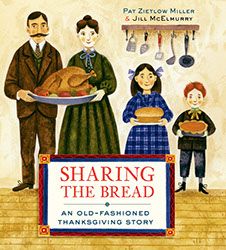
And now, just a few months later, I’m doubly fortunate to say Schwartz & Wade has acquired another of my picture books, Sharing the Bread.

It’s awesome news. In fact, I’m still beaming.

But I’ve heard a lot of comments like this:

“It’s cool you sold your second book so quickly after your first. It must only have taken you a few weeks to write.”

Um … no.

I’m sure there are authors who dash off a manuscript in an afternoon, read through it the next day, smile, add a few commas, change a word or two and send it off to editors who greet it with shouts of delight and fight for the right to publish it.

But that’s not me.

So I thought I’d share the evolution — so far — of this 310-word story.

The initial idea.

Three years ago, I was in a meeting. It had nothing to do with food, families or cooking, but out of somewhere, these words popped into my head: “Mama be a cooking pot, cooking pot. Big and round and black and hot. Mama be a pot.”

That’s stupid. I thought. How could someone be a pot? (As you can tell, I’ve got a pretty critical internal editor.)

My internal editor wasn’t done lecturing me either. Writing a rhyming book is HARD. And you are not a rhymer. Remember that awful rhyming story about okra you spent months slaving over before you realized it was awful? Hmm? Well? Do you?

But I kind of liked the rhythm, so I jotted the words down. During the next few weeks I played around with them until I had several verses about a family making a meal together. At first, each family member was pretending to be some part of the meal. I vaguely thought the story might be something kids could act out.

Early editing.

But thanks to the wise counsel of my internal editor who was, I believe, making gagging noises, I realized this was not a good idea. So I had the family gather the ingredients and cook the meal without any play-acting. Mama was no longer a pot.

Not knowing what else to do with the story, I sent it to my critique group at the time. They didn’t love it. So the story sat on my hard drive, largely ignored, for a year while I worked on other things.

It might have stayed there forever if I hadn’t needed a manuscript to send to another critique group I belong to. I didn’t have anything new, so I dusted the story off and sent it out, cringing a little as I did.

Are you kidding? asked my internal editor.

But these group members liked it. “You need to work on this some more,” they said.

More revision.

So I did. I used their feedback to make the verses stronger and the rhythm better. I consulted rhyming dictionaries and tried to be as creative as possible. I shared it with a few other writing friends and took their suggestions to heart. I spent lots of time staring off into space tapping out the story meter with my fingers to make sure it was correct. My cat thought I was playing. My family thought I was crazy.

When the story was as good as I could make it, I sent to to someone with a well-deserved reputation as an excellent rhymer for a paid critique. Her response echoed my second critique group’s, “I really like this. I think you should work on it some more.”

Fierce revision.

She suggested a more traditional rhyme scheme and shared a few books written in a similar vein. Even though I sighed at the thought of the work involved in changing my rhyme scheme, I knew her advice was valid. So I read the books, ripped my story apart and started rewriting. And re-rhyming. And tapping my fingers on my desk. Again.

The new story revisited both my critique groups, several writing friends and a few family members. I made more changes. Eventually, I sent it back to the rhyming expert. “I think you can sell this,” she said.

But don’t cue the balloons.

I was tempted to celebrate. After all, this writer said the same thing about the manuscript that eventually became my first sale. Then I remembered it had taken several years and several more revisions before that sale occurred. Still, I sent out some submissions.

I heard back more quickly than usual. One form rejection. One note saying this wasn’t quite right but to send other things that I wrote. One note saying it was lovely but too quiet to stand out in the marketplace. This last editor did mention that the story might do well with a holiday or educational hook.

By this time, I had acquired an agent, Ammi-Joan Paquette. She and I decided to add a holiday angle to the story by having the family prepare Thanksgiving dinner instead of an everyday meal. Joan also showed the manuscript to Anne Schwartz of Schwartz & Wade. Anne liked it, thought a Thanksgiving angle would be helpful and asked me to work on it some more.

What rhymes with turkey?

So I dug in again. Only to realize that not much rhymes with turkey. (“Jerky?” “Murky?” “Perky?”) Or with stuffing. Or mashed potatoes. So I put the Thanksgiving words in the middle of the sentences so I could rhyme more common sounds at the end. I pruned. I polished. I pulled out large chunks of hair. But, I persevered.

(By the way, I was going to post a photo with this blog showing me in the throes of revision. But when I revise, I run my fingers through my hair and end up with what my husband calls “edit head.” It is not an attractive sight.)

Joan liked this version, and sent it off to Anne. Anne liked it but shared an email full of further suggestions. So, in response, I varied my rhyme scheme slightly, added a refrain, deleted two stanzas, added a new one and reordered some of the others. The updated version went back to Joan. She had a few more ideas. I incorporated those, and Joan returned it to Anne.

Whew!

By this time, my internal editor and I were afraid we had used up all our chances to get this right. Personally, I was amazed at how much better the manuscript had become from the first time I’d thought it was done. But would Anne agree? Would it be enough?

A few days later, Joan called. Anne liked the manuscript and wanted to acquire it. To paraphrase Ernest Thayer, “There was joy in Mudville.”

But I’m still not done.

Anne wants me to work on it some more. I just got her line edits in the mail today.

And I seriously can’t wait to see how much better my story — and the ultimate book — will be after this next rounds of changes.

"Nowhere Girl" by A.J. PaquetteThe book featured on today’s blog has one of the most beautiful covers I’ve seen since the original cover of Cindy Pon’s Silver Phoenix.

And, happily, the story inside Nowhere Girl (Walker Books, 2011) by A.J. Paquette is just as lovely.

It tells the story of 13-year-old Luchi Ann, who knows nothing of her American heritage and has spent her entire life in a Thai women’s prison with her mother. But, after her mother’s death, Luchi Ann must set off on an uncertain journey to find her place in the outside world.

Publishers Weekly said, “The highly atmospheric setting and thoughtful, determined narrator create a memorable thriller about identity and belonging.”

But don’t take our word for it.

Listen to today’s guest reviewer.

————————————-

Rebekah reads "Nowhere Girl." Our reviewer: Rebekah

Age: 12.5

Things I like to do: Read just about anything. I can only think of two books that I have ever read that I didn’t like.

What I thought of this book: Nowhere Girl is about Luchi Ann Finn, an American born in a woman’s prison in Thailand. Her mother was secretive, and so Luchi Ann only knew a few things about her life: her name, which she wasn’t supposed to tell anyone, and that her mother, Helena Finn, was the only family that she had.

But when Luchi’s mother dies, the warden of the prison decides it’s not healthy for a girl to grow up in a cell and sends her away to learn about the world that, so far, she had only read about. The only item that she keeps is a strange letter that she is given by one of the women that she grew up with. It’s addressed to Helena Finn and from someone called Regina Finn — Luchi’s grandmother who lives in America.

Suddenly, Luchi’s journey has a purpose — to find the grandmother that she never knew, and also find the monster of a man who made her mother so afraid and secretive. It will be a hard journey, but Luchi is determined to unravel the tangled web of secrets that make up her life.

I got this book on Christmas Eve from my aunt. I started reading it that evening and had finished it by Christmas morning (probably staying up too late in the process.) From the very beginning, this book had me hooked. Luchi Ann’s story is a mystery that wraps you up in it and isn’t solved until the very end, so I found Nowhere Girl impossible to put down.

I would recommend this book to: Everyone, including adults, because it is such a real and touching story. I felt as if I’d known Luchi forever by the end of the book because of how much personality and life she had. Nowhere Girl is an amazingly powerful book, and I think anyone wanting to curl up with a good book should read it.

————————————-

Thanks, Rebekah!

If you’d like to learn more about the author, you can:

Author Sarah PrineasFantasy lovers discovered Sarah Prineas in 2009 when the first book of her Magic Thief series debuted.

It was an instant success with readers and reviewers, earning starred reviews from Kirkus, Booklist and the Bulletin of the Center for Children’s Books and also being named to the New York Public Library’s list of 100 Books for Reading and Sharing.

Two equally successful books followed in the series. And now, Sarah has released another fantasy, Winterling (HarperCollins, 2012).

Today, we’re honored to have Sarah visit Read, Write, Repeat to talk about her brand-new book.

Was it difficult to start another story after the success of The Magic Thief series?
It wasn’t difficult, no.  Writing is a real joy for me, so I was very excited to meet some new characters and find out about their story.

Sarah Prineas's newest book, "Winterling"Are their any similarities between your three Magic Thief books and Winterling? Are they for the same type of readers?
Both the Magic Thief books and Winterling are similar in that they’re for upper middle-grade readers, ages 10+, and they’re both fantasies.  They’re different in three ways.

One is that the Magic Thief books are “secondary-world fantasy;” that is, they take place in a world not our own.  Winterling is what’s known as a “portal fantasy,” because it starts in our world — in Iowa, actually! — and then takes the reader into another, magical world.

The second difference is that the Magic Thief books are in the first person; the books are narrated by the main character, a street-kid/wizard named Conn. Winterling is a third-person narration.

Finally, the main character of the Magic Thief books is a boy, and the protagonist of Winterling is a girl.

Winterling refers to Norse and Celtic mythology. What kind of research did you do to incorporate those myths into your story?
It’s kind of funny, actually. I went to the University of Iowa library and did a lot of research into fairy lore, especially the fairies of Ireland and Scotland and the Scandinavian countries.  But I never actually use the word “fairy” in the book.

An early review mentioned Winterling‘s many female characters. I was excited to hear that. Tell us how you “cast” the book and what you hoped to achieve?
That review (from Kirkus) made me laugh, because I hadn’t realized how girl-power the book ended up. I was really glad about it, though, because I certainly intended to write a book with strong female characters. There are strong girls and women in the Magic Thief books, too, but it’s a lot more obvious in Winterling.

What do you think Winterling readers might be most surprised by?
There are some turns in the book that I think are surprising, but I don’t want to give any of them away. Let’s just say that the main character, Fer, makes some unexpected choices at key moments in the plot.

What are you working on now?
I’m revising the companion novel to Winterling, which is called The Summerkin.

Anything else you’d like to share?

  • For any of your blog readers in Iowa, the landscape of our beautiful state was a huge inspiration to me as I was writing Winterling.  You’ll recognize the farms and the soybean fields, and the patches of wildness hidden in folds in the land.
  • Oh, and my publisher did a terrific book trailer for Winterling.
  • And for readers in the Iowa City area, there will be reading/signings at the Iowa City Public Library on Saturday, Jan. 7 at 1 p.m., and at Prairie Lights on Saturday, Jan. 14 at 1 p.m.

Thanks for stopping by, Sarah!

If you’d like to learn more about Sarah and her books, you can:

Vince strikes a pose.Editor’s note: Please welcome Vince, who periodically blogs about cat-related books, back to the site.

So, I’m back. I certainly wasn’t planning on it.

After all, I try not to make a habit of writing book reviews because then the people who feed me come to expect it. And goodness knows part of the mystique of being a cat is never, ever, relinquishing the upper hand.

Nevertheless, it’s a cold, Wisconsin winter. And after I’ve eaten, asked for treats, yowled to have the water turned on in the sink so I can drink that instead of what’s in my dish, taken a nap, raced randomly from room to room and then asked for more food, there isn’t much left to do.

So while I was racing from room to room, I knocked over a stack of books that was too high to begin with and discovered one called Won Ton: A Cat Tale Told in Haiku (Henry Holt and Company, 2011) written by Lee Wardlaw and illustrated by Eugene Yelchin.

It caught my eye immediately because the cat was the only thing shown on the cover. Which is as it should be. Too many books about cats put children on the cover. This one was smart enough to put its star front and center. And look below … he’s nearly as handsome as I am.

Won Ton by Lee Wardlaw and Eugene YelchinThis cat lives in a shelter. He has the basic necessities — food and a place to sleep. But he’s missing that certain extra something. You know. Someone to care when he yowls. Someone to cater to his cat-specific demands.

So people come to choose a pet. This cat knows the dogs are no competition. Because, really, a dog? Let’s be serious. He acts like he doesn’t care, but he’s hoping he’ll be chosen. And then … he is.

I don’t talk about it much, but I’ve been in this cat’s collar. I was in a shelter for three whole months before someone picked me. A few well-timed nose nudges from me to the woman who was obviously in charge of the decision sealed the deal. I consider it my best work yet.

This cat does a nice job of not letting his new family think he’s too grateful. He hides under the bed, turns up his nose at the food, scratches their sofa and leaves a present in one of their shoes. But he also puts up with being dressed up for tea, scares off a neighboring cat who surely had ill intentions and quite likes the little boy who chose him.

This book is written in haiku — and very nicely I might add. Here are two of my favorites:

Hel-l000. I’m waiting.
Put down that pesky pencil
and fetch the catnip.

I explained it loud
and clear. What part of “meow”
don’t you understand?

So if you’re looking for a good book about cats to educate yourself or others in you life, I’d give this one my pawprint of approval. The author has three cats she chose from a shelter, so she knows whereof she writes.

To learn more about Lee Wardlaw, the author, visit her website or watch this video interview.

To learn more about Eugene Yelchin, the illustrator, who definitely knows how to draw a cat, visit his website or read this interview.

Well, the gifts are open, and the wrapping paper has been mostly cleared away. So here are the books that found their way under several trees this year.

- One Day and One Amazing Morning on Orange Street by Joanne Rocklin.
- Nowhere Girl by A.J. Paquette.
- Spaceheadz (the first two books in the series) by Jon Scieszka.
- Beryl: A Pig’s Tale by Jane Simmons.
- Mental Floss The Book: The Greatest Lists in the History of Listory.
- Sheepish: Two Women, Fifty Sheep and Enough Wool to Save the Planet by Catherine Friend.
- The Dirty Life: A Memoir of Farming, Food and Love by Kristin Kimball.
- Twelve Days of Christmas in Wisconsin by Erin Eitter Kono.

What books did you give or receive this year?

Next Page »